Follow the signal
Sermorelin, from signal to response
A brief message to the pituitary, a longer hormone reply, and a much slower question about health. The timing is where this story gets interesting.
What is sermorelin?
Sermorelin copies the first 29 amino acids of growth hormone-releasing hormone, or GHRH, a brain hormone with a 44-residue chain. That shortened message still prompts the pituitary to release growth hormone. The pituitary is the small gland beneath the brain; the growth hormone comes from its own cells.
The release happens in bursts. Growth hormone then prompts the liver to produce IGF-1, a hormone involved in growth that also helps restrain further release. The body’s feedback controls remain involved when sermorelin supplies the stimulus. “Secretagogue” is the useful technical word here: something that prompts secretion.
That makes Direct an intriguing name for this peptide. There is a gland answering back, with its own timing and limits.
Two time measurements
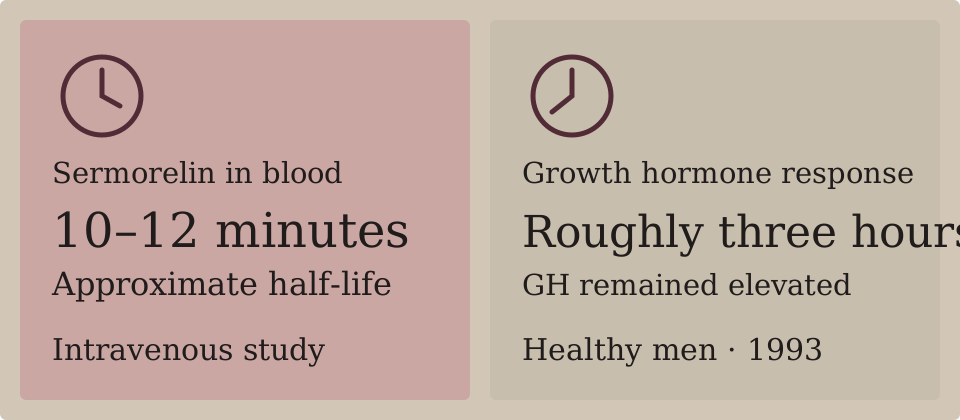
I expected sermorelin’s brief stay in blood to be the main obstacle. Then there was the study of 30 healthy men: after an intravenous injection, its plasma half-life was about 10-12 minutes, yet growth hormone remained elevated for roughly three hours. Half-life is the time taken for the blood concentration to fall by half.
The reply outlasted the message. The delayed reply introduces sermorelin more usefully, I think, than the usual catalogue of hoped-for benefits. Drug exposure and the gland’s response run on different clocks.
Children’s growth
The clearest benefit here can be measured against a wall. In prepubertal children with growth hormone deficiency, first-year height velocity increased from about 4.1 to roughly 7-8 centimeters per year, without excessive IGF-1 generation.
The childhood outcome persuades me because a real growth problem was measured. These children had a defined growth problem, and the outcome was growth. The pediatric diagnosis and treatment review explains how sermorelin served both as a stimulus for testing the gland and as a treatment. More of that history is in the human studies.
Adult aging
The adult result that attracts so much attention came from a much shorter experiment. The study followed older men with a mean age of 68 for 14 days. At the higher study amount, their GH and IGF-1 measurements no longer differed from younger men’s; fasting glucose was unchanged.
A younger-looking hormone profile is an appealing result. I balk at treating it as an answer about strength, daily function or healthier years: those gains still need to be measured. The editorial caution about secretagogues for aging addresses precisely that unfinished business.
Approval and compounded sermorelin
Sermorelin’s former U.S. approval concerned childhood growth hormone deficiency and diagnostic use. Sales of the approved product ended in 2008 for commercial reasons; safety or effectiveness problems were not the reason. A clinical review described the diagnostic gap after discontinuation.
Today, sermorelin is treated as a Category 1 bulk substance under FDA’s interim Section 503A compounding policy. Patient-specific preparation requires a valid prescription from a licensed clinician who has assessed the individual. A compounded sermorelin preparation has no FDA approval. The former product’s approval and today’s preparation each have their own status.
Sleep, dosage and safety
The effects page starts with the sleep and energy stories people actually tell. Sermorelin dosage stays with the people, routes and amounts in the studies, including the confusion around mL and syringe units.
For a less comfortable experiment, follow the safety record: a continuous supply produced a fading hormone response in children. The CJC-1295 comparison takes up the attraction of a longer-lasting signal.